
The Playback Rule: Active Listening in Action
Blog post description.
TALENT MANAGEMENT
Jerrell Bravo
12/11/20252 min read
Leaders often think the hardest part of giving feedback is choosing the right words.
It’s not. The hardest part is listening long enough to understand what’s actually going on.
When you’re running a growing team, repeated conversations cost time, energy, and momentum. You can’t afford to “fix” the wrong problem because you didn’t listen fully before responding.
Every framework, including AID, falls apart if the manager isn’t listening. You can’t gather the Action or understand the true Impact if you’re thinking about your response instead of their reality.
Rushing to conclusions doesn’t speed things up. It guarantees you’ll repeat the same conversation next month.
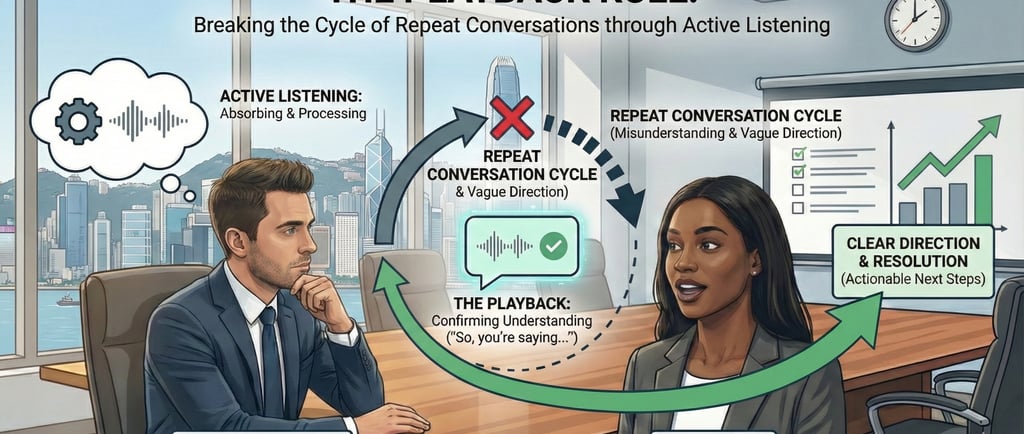
Active listening breaks that cycle.
Why Active Listening Makes Feedback Work
1. Listening Gives You the REAL “Action”
Saying, “You dropped the ball,” isn’t describing an action; it’s delivering a verdict. Active listening forces you to ask:
“What actually happened?”
“What led up to this?”
Once you hear specifics, the conversation becomes factual instead of emotional. Defensiveness disappears on both sides.
2. Listening Reveals the Real “Impact”. From Their Side
Impact isn’t one-sided. Before you explain how their actions affected the business, you need to understand what affected them.
Maybe they lacked context. Maybe priorities changed. Maybe you assumed they understood expectations, but they didn’t.
Active listening uncovers these blind spots so the feedback becomes a shared truth, not a power play.
3. Listening Sets Up Better “Direction”
Direction only works when it aligns with reality. If you don’t fully understand the situation, your “next step” will be vague or impossible to execute.
A Tip You Can Use Today: The Playback Rule
Before you offer any Direction, follow this rule:
You aren’t allowed to give feedback until you can summarize their reality, and they agree with it.
It sounds like:
“Just to confirm I’ve got this right: you didn’t send the update because you were waiting on the finance numbers?”
If the answer is no: ask again.
If the answer is yes: you’ve earned the right to move forward.
Bonus: The 3-Second Pause
After your playback, wait three seconds before speaking. The silence signals that you’re thinking with them, not reacting at them.
Small habit. Massive impact.
The Takeaway
Active listening is the invisible skill behind every effective leadership tool. When you listen properly, feedback stops feeling like confrontation and starts becoming alignment.
Active listening is the foundation.
AID is the structure.
Together, they turn managers into leaders.